The frost delay playbook: one trigger, five actions, zero staff time
Frost at 6am means 45 minutes to notify golfers, update voicemail, post to social, and text staff. At most courses, two of those five actually happen.
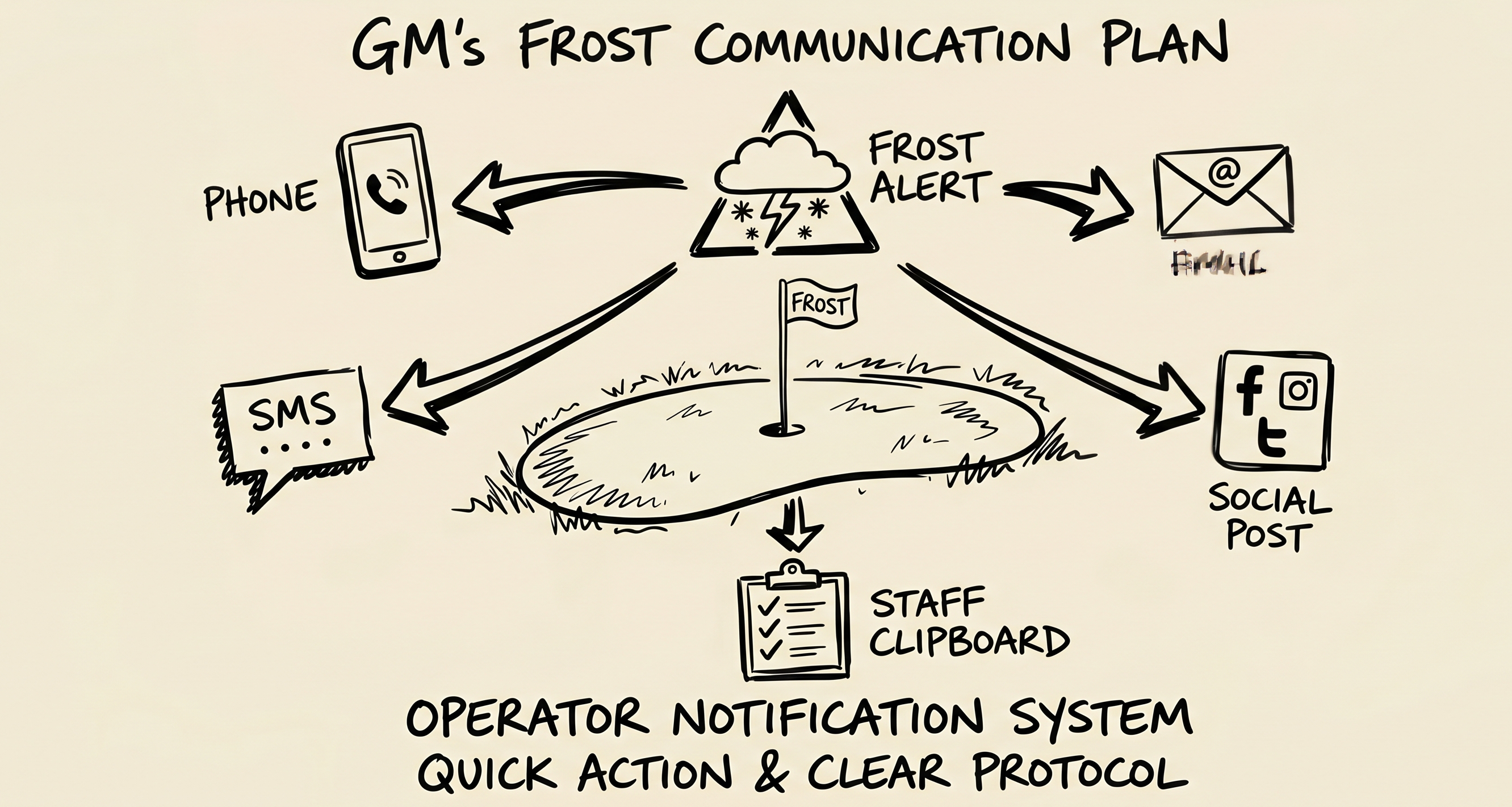
It’s 6:02am on a Saturday. The superintendent calls it: frost delay, at least 45 minutes. The GM now has a narrow window to reach every golfer with a 7–9am tee time before they leave the house.
The clock is already running.
Most GMs manage to send an email — maybe by 6:40. Text the starter. Update the voicemail if they remember the passcode. Social media, the Google Business profile, and the two staff members who need to know their schedule shifted? Those happen later. Or not at all.
Why the delay is non-negotiable — and why you still lose
The superintendent isn’t being cautious for the sake of it. When frost forms, ice crystals grow inside the plant cells of the turf. Traffic — including golfers walking the fairway — ruptures those cells. According to the USGA, damage can show up days later as dead tracks across the green, and if the growing point of the plant is compromised, recovery can take months. A foursome takes 300 steps on each putting green. Multiply that across an 18-hole morning and you’re looking at turf damage that costs far more than one morning’s green fees.
So the delay happens. That part is right.
The failure is everything that comes after the call is made.
The email arrives after the car leaves the driveway
Here’s the timing problem in plain terms. A golfer with a 7:15 tee time will typically leave the house around 6:15–6:30 to allow time to arrive, warm up, and get to the first tee. If the delay is called at 6:02 and the email goes out at 6:40, that golfer is already driving.
Email doesn’t work for this. Peak email open rates cluster between 9:00–10:00am on most days — data from MailerLite’s 2026 analysis puts Thursday 9am open rates at 46.3%, the week’s highest. A 6:40am email to someone who is in their car or already at the range is not a notification. It’s a discovery they’ll make when they sit down for breakfast after the delay lifts.
SMS is the only channel that reaches people in real time. About 60% of consumers read a text within 1–5 minutes of receiving it, and the average response time to an SMS is 90 seconds — compared to 90 minutes for email. For the earliest tee times, a text sent at 6:03am reaches the golfer before they hit the road. The email you send at 6:40 does not.
The five things that need to happen — in parallel
Here is what a complete frost delay response actually looks like. Not sequentially. All of it, at once:
- Email to affected tee times — everyone booked between the scheduled opening and estimated clear time. Subject line includes the delay window and the expected restart.
- SMS to the earliest bookings — the 7:00–8:00am slots who may have already left or be about to. Same information, shorter format, immediate delivery.
- Voice agent greeting updated — anyone who calls the pro shop in the next two hours should hear an accurate recording, not yesterday’s outgoing message or silence. The greeting should update automatically when the delay is called and revert when play resumes.
- Social and Google Business post — a brief factual update. Golfers check your Google listing when they can’t get through on the phone. The post takes 90 seconds to write and three hours to matter if it goes up late.
- Staff notification — the starter, the range attendant, anyone whose opening task changes because of the delay. A Slack message or a group text. Thirty seconds of work that prevents three confused conversations at 6:45am.
At most courses, items 1 and 5 happen. Items 2, 3, and 4 depend on who remembered and when.
What “pre-wired” means in practice
The difference between a handled delay and a scramble is not effort — it’s whether anyone built the response before the weather showed up.
Pre-wiring means: document the trigger (“frost delay called by superintendent”), name the five actions, assign ownership for each one, and set a time-to-complete expectation (SLA) per action. Then run it the same way every time.
The GM who built this playbook in October runs a frost delay in February without thinking. The one who didn’t is still looking for the voicemail passcode at 6:25.
What to do on Monday
You don’t need automation software to build this. You need a document and twenty minutes.
- Name the trigger. “Frost delay called” is the event. Everything below fires from this.
- List the five actions. Tailor the wording to your course, but keep the structure above.
- Assign an owner to each. Not a role — a name. “Whoever is opening” fails under pressure.
- Write the templates now. The email, the SMS, the social post, the voice greeting update script. Write them once when you’re calm; don’t write them at 6:05am.
- Set a completion SLA. All five actions in under 10 minutes from the call. If that’s not achievable with your current setup, that’s the gap to close first.
- Run a dry drill. Call a fake delay in a team meeting. Time it. Find the gaps before the frost does.
Tape the one-page playbook to the inside of the pro shop cabinet. Put it in the opening checklist. The GM shouldn’t have to remember any of this — the system should remember it for them.
The Fairwai angle
This is where Fairwai runs the playbook instead of you. Set the trigger — frost delay longer than 45 minutes — and Fairwai sends the emails to affected tee times, texts the earliest bookings, updates the voice agent greeting, posts to Google Business and your social accounts, and notifies the staff on duty. All five actions, in parallel, in under two minutes. By the time the GM walks through the door, the delay is already communicated. The inbox is not waiting for them; it’s handled.
Build the playbook this week. Then wire it once so it runs itself.